


 English
 中文简体
中文简体
In April 2024, the U.S. EPA finalized enforceable national limits for six PFAS compounds in drinking water, setting the PFOA and PFOS maximum contaminant level at 4 parts per trillion, seventeen times lower than the combined 70-ppt advisory it replaced. A question once confined to utility engineers has since reached store shelves and procurement departments: which filters actually handle PFAS and other emerging contaminants, and which merely look convincing?
The effective answer is narrower than most packaging suggests. Three technologies carry a documented track record: activated carbon adsorption, reverse osmosis, and ion exchange. Everything else, including sediment cartridges, mesh screens, and basic faucet aerators, does essentially nothing against PFAS, because these compounds are dissolved molecules far smaller than any mechanical pore. Within the three effective categories, independent testing shows results ranging from nearly complete removal to almost none. The difference lies in contact time, media quality, membrane condition, and replacement discipline, not in the wording on the box.
Why PFAS Defeat Conventional Filters
PFAS, or per- and polyfluoroalkyl substances, are built on chains of carbon atoms bonded to fluorine, one of the strongest bonds in organic chemistry. That structure shrugs off heat, acids, and microbial attack, which is why these compounds persist for decades and earned the nickname "forever chemicals." It also defines the filtration challenge: nothing a household filter contains can destroy PFAS. Filters can only relocate them, onto a carbon surface, into an exchange resin, or down the drain as membrane reject.
Two further properties make PFAS awkward targets. In water they exist as dissolved, negatively charged anions rather than particles: a PFOA molecule measures on the order of a nanometer, while a standard polypropylene sediment cartridge filters down to 1 to 5 microns, a gap of roughly a thousandfold. A sediment filter remains indispensable pre-treatment for a purifier, but expecting it to catch dissolved PFAS is like expecting a tennis net to stop smoke. Chain length then changes everything: long-chain compounds such as PFOA and PFOS adsorb readily onto carbon, while the short-chain replacements adopted after the phase-outs, PFBA and PFBS among them, break through exhausted carbon far faster.
| Technology | Capture mechanism | Typical performance | Main limitation |
|---|---|---|---|
| Activated carbon (GAC or carbon block) | Adsorption onto porous carbon surfaces | Around 70 to 75% average removal in independent point-of-use testing, with wide product-to-product variation | Capacity exhausts silently; short-chain compounds break through first |
| Reverse osmosis | Rejection at a dense polyamide membrane under pump pressure | Commonly above 95% for most PFAS, including many short-chain compounds | Needs adequate feed pressure, pre-treatment, and drain routing |
| Anion exchange resin | Charged resin sites hold negatively charged PFAS | High capacity with selective resins, widely used at utility scale | Spent resin requires regulated disposal or regeneration |
Any serious PFAS discussion therefore has to name the technology, the compounds tested, and the conditions of the measurement. Generic phrases like "removes contaminants" carry no information at all.
Activated Carbon: Adsorption With a Deadline
Activated carbon is the most affordable and most widely deployed PFAS-reduction option, and it does work when three conditions hold: the carbon is fresh, the contact time is generous, and the reduction claim is certified for the specific compounds. The mechanism is adsorption. One gram of activated carbon exposes several hundred square meters of internal surface through its pore network, and the water-repelling fluorinated tail of a PFAS molecule anchors onto that hydrophobic surface while the charged head faces the water. The contaminant stays put while the water moves on.
Real-world results vary enormously. Independent university testing of point-of-use filters found activated-carbon units removed about 73 percent of PFAS on average, but the spread was so wide that some units approached complete removal while others left most of the contamination in the glass. A peer-reviewed 2025 assessment of pitcher and bottle filters recorded average removal ranging from 31 to 99 percent across twenty legacy compounds, with some individual compounds falling as low as 19 percent. The average is encouraging; the spread is the actual finding, because carbon quality and cartridge design dominate the outcome.
The underlying process deserves its own explanation, and this guide to how activated carbon filtration works covers media production and adsorption behavior in detail.
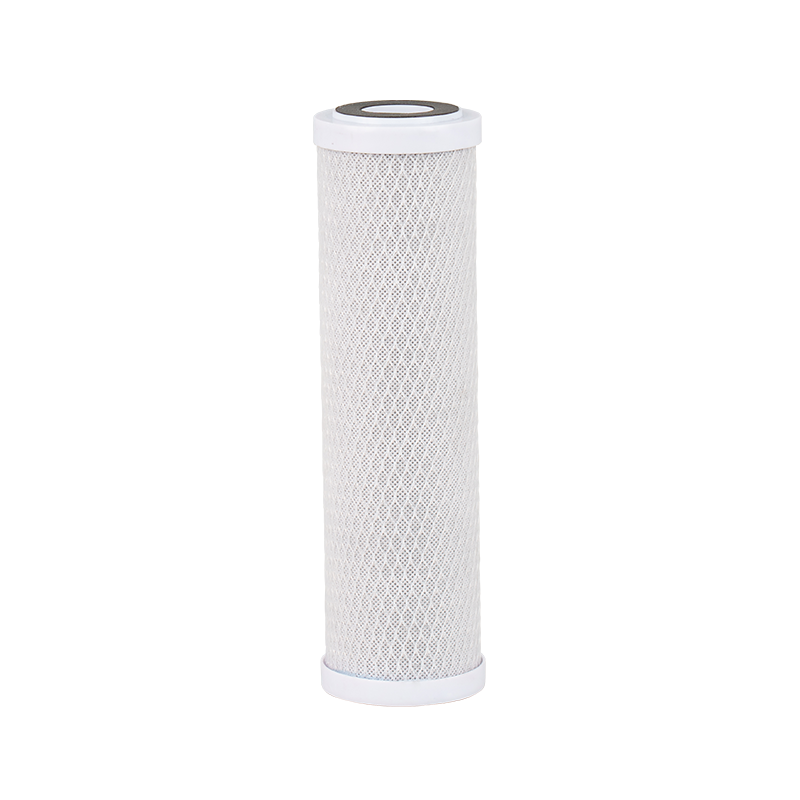 10 Inch CTO Carbon Block Pre-Filter CartridgesThis extruded carbon block offers denser media contact than granular carbon, making it a relevant sediment and chlorine pre-treatment stage ahead of RO in PFAS-focused systems.View Product →
Carbon block versus granular carbon
Carbon block (CTO) cartridges are extruded into a dense, uniform matrix that forces water into intimate contact with the media, delivering longer effective contact time per cartridge volume. Granular carbon (UDF) relies on loose media where high flow rates can open preferential channels that water races through with little adsorption. At equal size, a well-made carbon block generally holds the advantage for PFAS duty, though neither should be trusted without a certified reduction claim behind it.
Exhaustion is silent
Carbon never announces that it is spent. As adsorption sites fill, PFAS, short-chain compounds first, begin slipping through, and testing has documented cases where exhausted filters returned water containing PFAS at levels comparable to or above the unfiltered feed. The replacement interval is therefore a safety parameter rather than a suggestion; six-month cartridge changes are common guidance in PFAS applications. Chlorine adds a second deadline: carbon is also what protects a downstream polyamide RO membrane from chlorine attack, and a spent carbon stage quietly shortens membrane life.
Reverse Osmosis: The Broadest Rejection
When one stage must cover long-chain PFAS, short-chain PFAS, and the rest of the emerging-contaminant list together, reverse osmosis is the default answer. An RO membrane is a dense polyamide film: under pump pressure, water molecules pass through while dissolved ions and fluorinated anions are rejected alongside them. Rejection of PFOA and PFOS commonly exceeds 95 percent, and modern low-pressure membranes extend strong performance to many short-chain compounds that exhaust carbon quickly. The same membrane also addresses arsenic, nitrate, lead, and total dissolved solids, which is why point-of-use RO remains the benchmark residential treatment for PFAS.
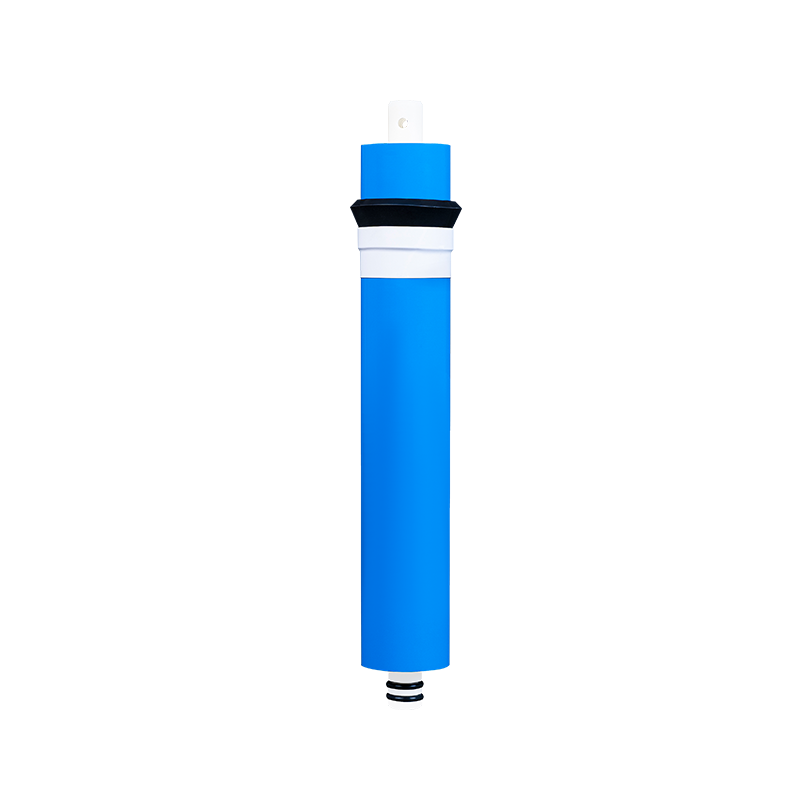 Household Membrane RO Water Filter CartridgeA polyamide RO membrane for under-sink use, positioned here because reverse osmosis rejects PFOA, PFOS, and many short-chain PFAS along with lead, nitrate, and arsenic.View Product →
How the stage chain keeps the membrane alive
A typical residential system runs sediment filtration, then carbon block, then the RO membrane, then post-carbon polishing, with an optional mineralization cartridge afterward to restore taste minerals. Each upstream stage has a defined job, and the membrane's performance depends on the hydraulics around it: stable feed pressure, a pressure switch that cycles the system correctly, and periodic flushing that clears concentrate from the membrane surface. An automatic flush valve that rinses the membrane at startup measurably slows the fouling that drags rejection rates down, which is why flush control has become standard in RO system design.
The same physics at industrial scale
Municipal and industrial systems use identical rejection chemistry in larger element formats, and element selection follows feed water chemistry: high-rejection brackish water elements are the usual choice for PFAS-laden groundwater, high-rejection seawater elements serve desalination duty, and low-energy elements trade a small rejection margin for significantly lower pumping cost. The system's pumps and control valves are then sized around the element. An overview of available RO membrane elements shows how household and industrial formats share one separation principle.
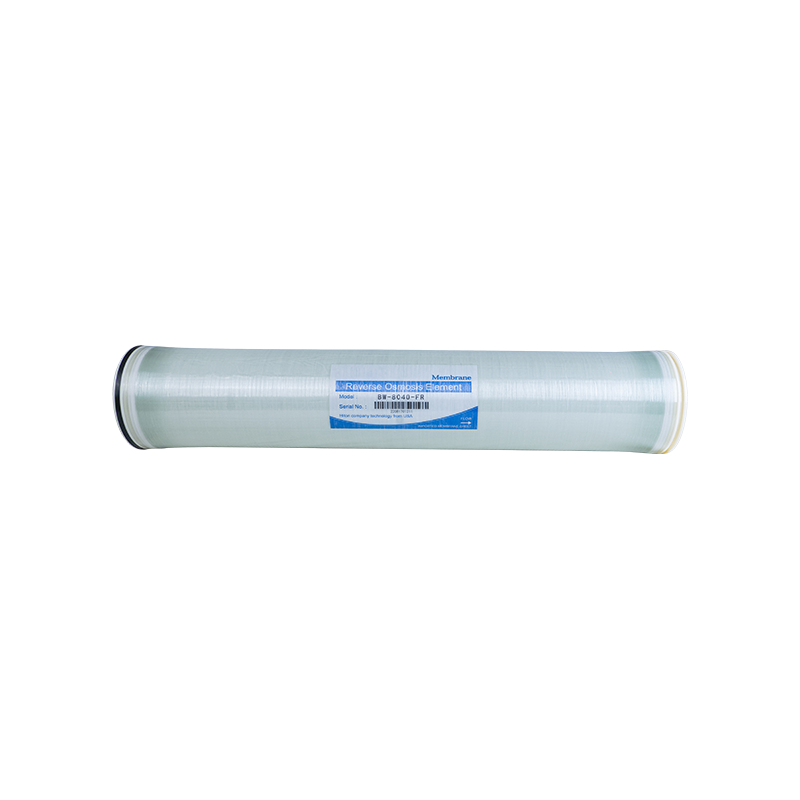 BW-8040 Brackish Water High Rejection RO MembraneThis high-rejection brackish water element suits PFAS-laden groundwater, offering the strong dissolved-contaminant rejection that municipal and industrial RO systems require.View Product →
Ion Exchange: High Capacity, Careful Handling
Anion exchange resin carries positively charged sites that attract and hold negatively charged PFAS, and selective resins achieve higher capacity than carbon against difficult short-chain compounds, one reason utilities deploy it alongside or instead of granular carbon. Two cautions keep expectations honest. Competing anions such as sulfate and nitrate consume capacity first, so design demands actual water chemistry data. Spent resin also concentrates everything it captured, which makes regulated disposal or proper regeneration mandatory; a saturated cartridge is hazardous waste in waiting. Households mostly meet ion exchange inside certified two-stage pitcher cartridges, while system integrators treat it as an engineering decision backed by analysis rather than a standalone fix.
Certification and Procurement Checks That Matter
Certification separates measured performance from marketing, and three standards cover the relevant hardware:
- NSF/ANSI 53 verifies health-effect reduction claims, including PFOA and PFOS, for carbon-based and other point-of-use treatment units.
- NSF/ANSI 58 applies to reverse osmosis systems, covering both contaminant reduction and system integrity.
- NSF/ANSI 401 addresses incidental emerging compounds, the broader category behind the PFAS headlines.
A logo alone is not the deliverable; ask for the claim sheet listing exactly which compounds were tested and the measured reduction percentage. Four further checks protect the investment:
- Match the flow rating. A cartridge operated above its certified flow will not reproduce the certified result, because PFAS adsorption needs contact time measured in minutes rather than seconds.
- Price the maintenance. Carbon stages in PFAS service typically need replacement around every six months and RO membranes every 24 to 36 months, so calculate five-year consumable cost rather than first-unit price.
- Check media specifications. Iodine number, mesh size, and whether a carbon block is extruded or simply packed predict capacity far better than brochure language.
- Confirm construction consistency. A certification applies to a defined build, and OEM or import buyers should verify that media sources and manufacturing processes do not change quietly within a supply chain.
PFAS in drinking water is a chemistry problem, and it yields to chemistry: fresh adsorption media given enough contact time, intact membranes held at the right pressure, or exchange resin with capacity to spare. Mechanical filtration earns its place as the supporting layer that keeps those media alive, not as the hero. Whether the decision concerns a single countertop unit or component sourcing for a product line, the same checks apply: verified reduction claims for specific compounds, a replacement plan matched to real water use, and components that hold the primary media within its intended operating window. A current test of the local water supply turns each of those checks from guesswork into arithmetic.

